
Digital sovereignty: where is your data really hosted?


For some time now, one question has been coming up more and more often in our conversations with organizations interested in Piwigo: where is our data hosted?
Concerns about digital sovereignty, dependence on large cloud platforms and increasing regulatory requirements are leading many organizations to look more closely at where their data is hosted and who controls the underlying infrastructure.
At Piwigo, this question has been part of our thinking for a long time. The project has always been built around a simple principle: giving organizations control over their data and their infrastructure.
Why digital sovereignty is becoming an issue
The question of digital sovereignty is becoming increasingly important for organizations.
Around the world, many companies and institutions are realizing that their digital tools often rely on cloud infrastructures operated by a small number of large technology providers.
This can raise several concerns:
- technological dependence on a single provider
- legal uncertainties regarding data location
- difficulty maintaining full control over infrastructure
In this context, some organizations are looking for solutions that allow them to regain control over their data and their hosting environment.
This principle has always been at the core of the Piwigo project.
A transparent and sovereign approach from the beginning

From the beginning, we chose transparency and full control over our infrastructure.
Customers using the piwigo.com SaaS service are hosted on OVH servers in France, one of Europe’s largest cloud infrastructure providers. The platform is operated directly by our team, including updates, monitoring, backups and security. If you’d like to learn more, read this article.
This approach allows us to run Piwigo without relying on the large cloud platforms that dominate today’s infrastructure market, while keeping full visibility over how the service operates and where data is stored.
For many organizations, this provides the right balance: the simplicity of a SaaS service combined with clear control over data hosting and platform operations.
This choice is part of Piwigo’s DNA, and it will not change.
However, some organizations have specific constraints and want to go even further in controlling their infrastructure.
Self-hosting: full control over your infrastructure
Some companies and institutions prefer to host their data on their own servers, within their own infrastructure.
As a free and open source software project, Piwigo can of course be hosted by you (self-hosting).
You can install Piwigo:
- on your own servers
- on a private cloud
- with the European hosting provider of your choice
This way, you keep full control over both your data and your infrastructure.
This is one of the major advantages of open source software: you are not locked into a single vendor.
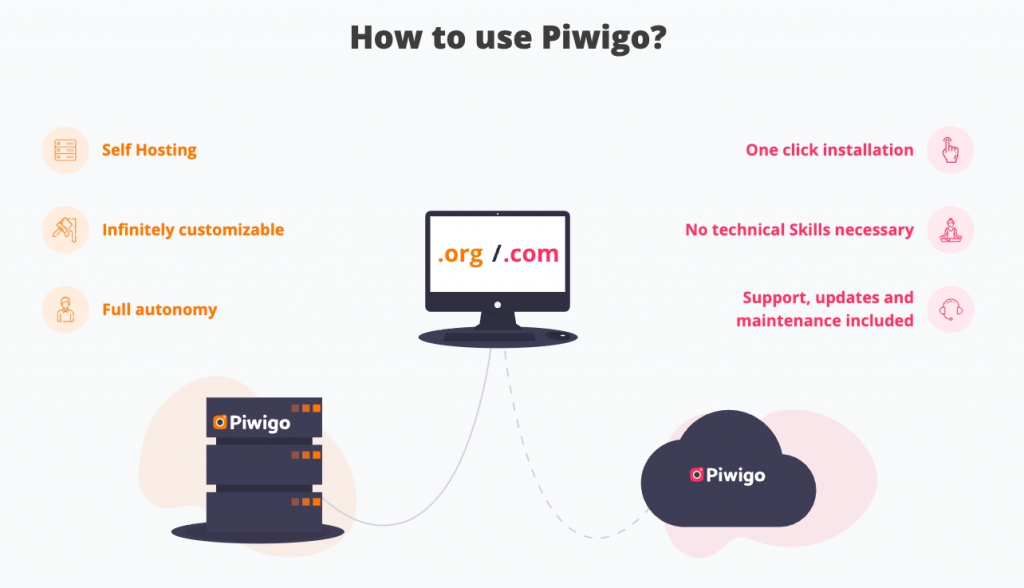
What is vendor lock-in?
Many SaaS products rely on a model known as vendor lock-in.
In this model:
- your data is stored in a closed platform
- exports are limited or incomplete
- switching solutions becomes complex and expensive
With Piwigo, we made a different choice.
Because Piwigo is open source, you always retain control over your media library:
- your files remain accessible in their original format
- your media files remain stored in standard formats and can be accessed directly if needed
- you can export your entire library at any time
- you can host Piwigo wherever you want
In other words, you remain free to choose your infrastructure and keep control of your data.
The downside of self-hosting
Self-hosting offers great freedom, but it also comes with technical challenges.
Over the years, we have seen many Piwigo installations run into problems for fairly simple reasons:
- Piwigo was installed once… and never updated
- the server is not properly configured
- PHP or database versions become outdated
- no one monitors disk space or performance
- users are not always aware of everything Piwigo can do
In some cases, we even see installations stuck on very old versions, which can lead to security or compatibility issues.
And very often, teams contact us in an emergency, when the server starts failing or the media library stops working properly.
New services to support self-hosted installations
To address these situations, we have redesigned our service offerings for organizations running Piwigo in self-hosted environments.
Our goal is simple: allow organizations to maintain full control over their infrastructure while benefiting from the expertise of the Piwigo team.
We now offer three types of services.
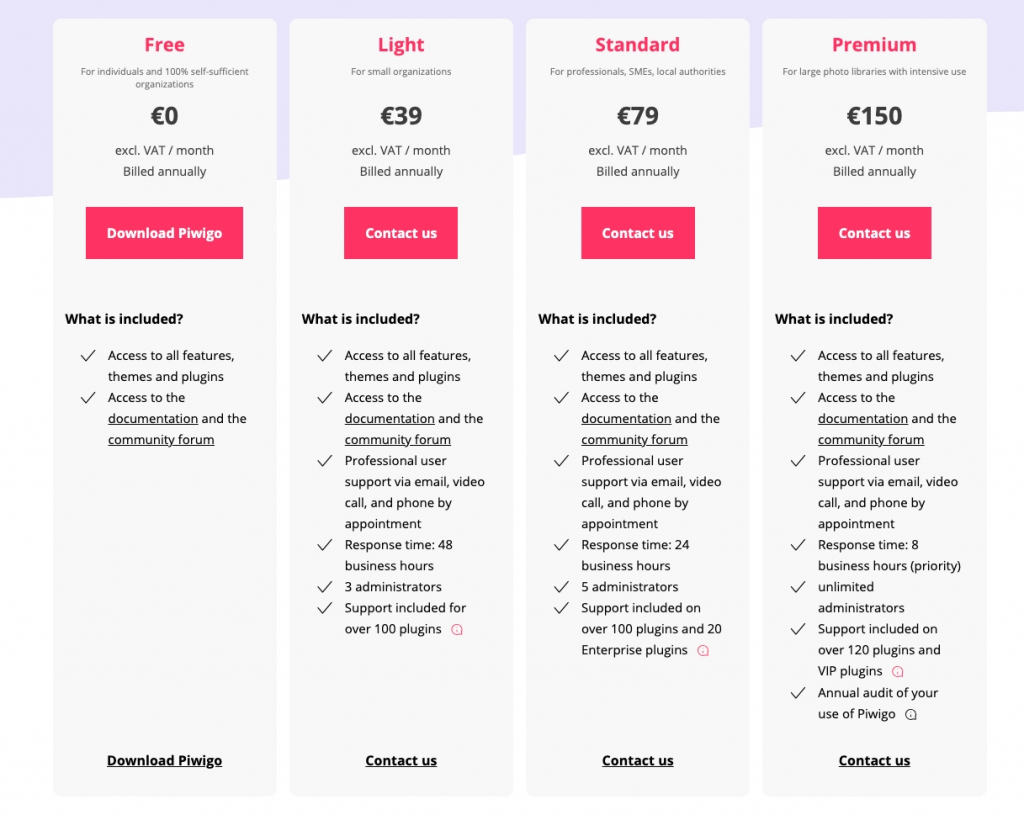
1. Support plans for all budgets
We offer several support levels, starting from €39 per month up to €150 per month, depending on the level of assistance required.
These plans allow organizations to benefit from expert advice from the Piwigo team and receive help when technical issues arise.
2. Technical assistance and managed services
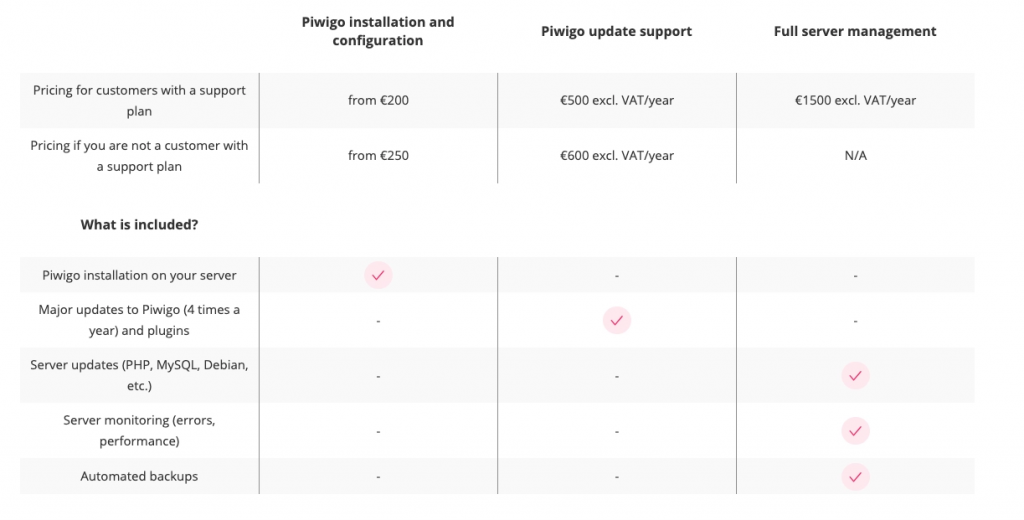
For organizations that want to secure their installation, we also offer technical services such as:
- installing Piwigo on your server and configuring the environment properly
- an annual plan that includes all Piwigo updates
For organizations that do not want to manage infrastructure themselves, we also provide a fully managed service.
In this case, our team handles not only the installation of Piwigo and server configuration, but also Piwigo updates, system updates, monitoring, supervision and backups.
You keep the hosting within your own infrastructure, but we take care of the technical operations.
A European alternative for managing media
Today, many photo library or Digital Asset Management solutions rely on cloud infrastructures operated by a small number of large cloud providers.
Piwigo offers a different approach:
- open source software
- developed by a European company
- available as SaaS or self-hosted
- with full transparency about the infrastructure
Organizations can therefore choose the solution that best fits their needs while maintaining full control over their data.
Learn more
If you are using Piwigo in a self-hosted environment and would like to secure your installation or benefit from technical support, discover our new offers.
And if you are already using one of our hosted plans, you can rest easy: you have chosen a solution hosted in Europe that gives you full control over your data and your infrastructure.
