
Piwigo API: unlock the full potential of your photo library

Discover how the Piwigo API allows you to automate workflows, connect your tools, and use Piwigo as a reliable image and video management backend for third-party digital platforms.
What is the Piwigo API?
The Piwigo API is an interface that lets you interact programmatically with your photo library, without using the web administration interface. It provides access to most of Piwigo’s features: uploading files, creating or editing albums, managing tags and users, or deleting content.
The API documentation is available on GitHub. To make things easier, Piwigo also provides a visual interface that lets you test each API method directly on your own data.
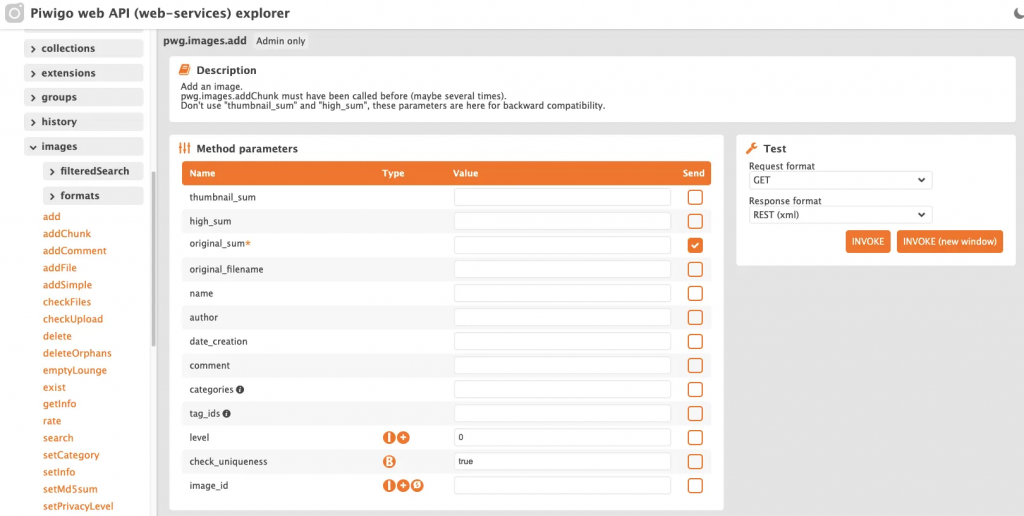
To access it, simply go to: [yourpiwigo.com]/tools/ws.htm – first replace [yourpiwigo.com] with your own Piwigo URL.
An API available to all users
Whether you have subscribed to a Piwigo Cloud plan or are running Piwigo in a self-hosted environment, the API is available at no extra cost.
- Piwigo Cloud customers: the API is included in your subscription, with no request limits.
- Self-hosted users: since Piwigo is open source, the API is a core part of the software and remains fully accessible.
Unlike many digital asset management solutions, Piwigo does not charge API usage based on the number of requests.
Why use the Piwigo API?
The API allows you to go beyond standard usage of Piwigo. Common use cases include:
- Automating repetitive tasks: automatically importing large volumes of images or updating metadata.
- Connecting Piwigo to internal tools: ERP, CMS, PIM, websites, intranets, or business applications.
- Using Piwigo as an image and video backend for another platform: in this setup, the Piwigo administration interface is rarely used, as all operations are handled via the API.
Real-world API use cases
Some organizations use Piwigo as a digital asset manager that is fully or partially driven by API calls.
EarthScope / UNAVCO
EarthScope / UNAVCO manages an international network of geophysical stations (GPS / GNSS) used to monitor movements of the Earth’s crust. On their website, stations are displayed on an interactive map with detailed information. Each station page includes a photo tab powered by the Piwigo API.
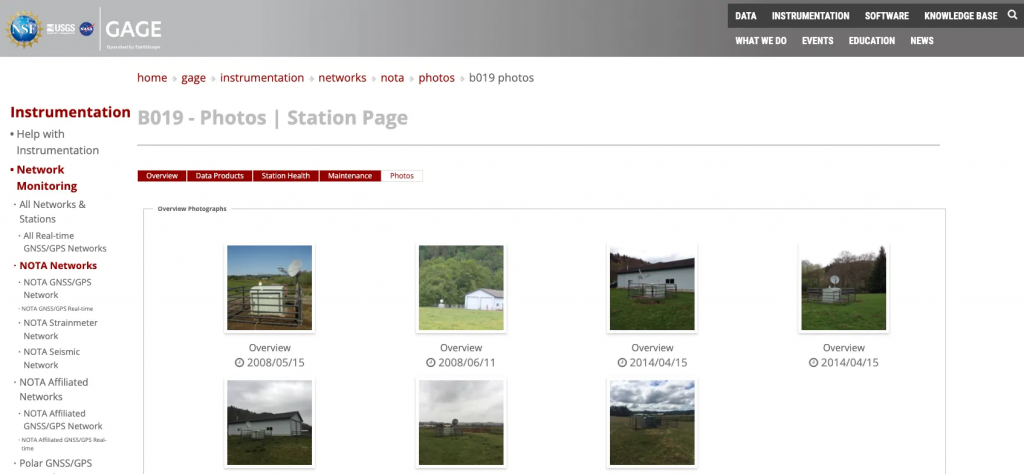
- Field photos are uploaded to and organized in Piwigo.
- The front-end queries the API to retrieve images associated with each geolocated station.
- Each station page displays its related photos dynamically via the API.
- Behind the scenes, the system handles a high volume of API requests.
Akena Véranda
Akena Véranda (a manufacturer of verandas and aluminium structures) relies on an internal user management system. Their goal was to provide seamless, secure access to the Piwigo photo library from their internal portal, fully synchronized with their corporate directory.
- A background service synchronizes users from the internal directory with Piwigo via the API (creation, updates, deletion).
- When a user accesses the photo library from the internal portal, an API call generates a dedicated access key or token, matching the user to their Piwigo account (a custom, in-house SSO system).
ZF
ZF is an automotive parts manufacturer with strong requirements for quality control and traceability. During production runs, an image sample (for example, 12 parts out of thousands) is photographed from all angles. These images must be easy to identify, organize, and retrieve if an issue is detected later.
- Automated scripts handle the entire workflow via the API: generating tags (lot number, date, orientation), associating tags with images, and uploading photos to the correct albums.
- If an incident occurs, all images related to a specific production batch can be quickly retrieved using tag-based or date-based searches.
Piwigo as a digital asset management API
The Piwigo API enables advanced use cases similar to those offered by proprietary Digital Asset Management (DAM) solutions. In practice, your Piwigo library can become:
- a centralized engine for managing images and videos,
- an automated content source for websites or e-commerce platforms,
- a connected media library integrated into your business applications.
In English-language contexts, Piwigo can also be described as a photo management API or a digital asset management API.
With two key advantages:
- Open source: the codebase is open and documented, with no vendor lock-in.
- Unlimited and included API access: no hidden fees and no usage-based pricing.
Conclusion
The Piwigo API is a powerful tool for automating workflows, connecting systems, and integrating your photo library into your own digital ecosystem. Whether you use it simply to import files from external sources or as a full-scale backend managing millions of images, the API is included with Piwigo, with no additional cost or limits.
👉 To learn more and start testing the API, visit the official documentation.
